
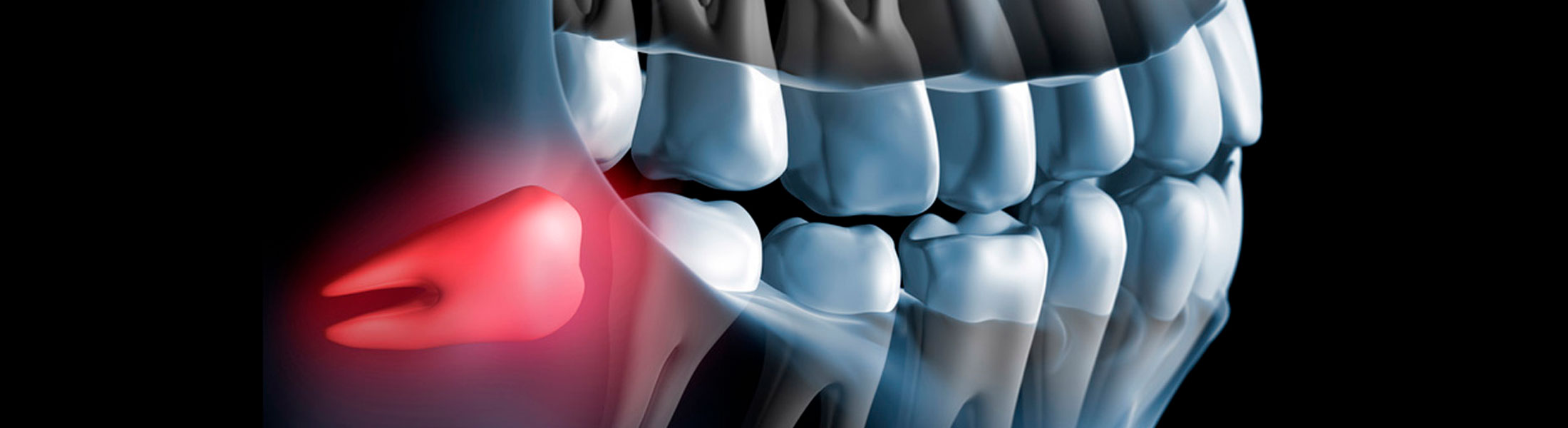
Wisdom teeth and surgical tooth removal
A routine procedure – planned, gentle and on request in twilight sedation or under anaesthesia.
When removing a tooth makes sense
A surgical tooth removal can become necessary if tooth roots are brittle, if a tooth neck is destroyed or badly damaged or if the tooth root is curved or angled.
At Zahnzentrum Frankfurter Bogen a tooth extraction is a routine procedure that we usually carry out under local anaesthetic. If the tooth is in a complicated position, if several teeth are being removed or on request, the procedure can also be performed under anaesthesia or in twilight sedation (analgosedation).

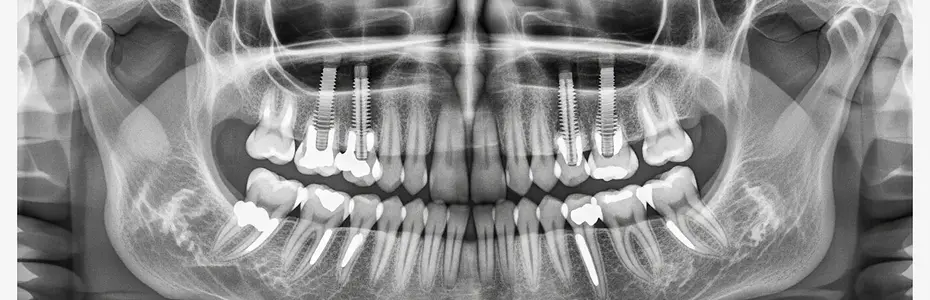
Wisdom teeth: displaced, impacted, partially impacted
If there is not enough space, wisdom teeth cannot take their place in the row of teeth. They remain in the jaw covered by bone (impaction) or come through only partially (partial impaction).
Reasons for surgical removal are inflammation of bone and mucous membrane, the risk of damage to or displacement of the neighbouring teeth as well as the formation of cysts in the area of impacted teeth.
If the wisdom tooth lies close to the mandibular nerve, we take a three-dimensional volume tomography beforehand. In this way we minimise the risk of nerve damage during removal.
The most important points at a glance
- Wisdom teeth do not have to be removed as a matter of principle – the findings are decisive.
- Reasons for removal are inflammation, lack of space, damage to neighbouring teeth and cyst formation.
- The procedure is usually carried out on an outpatient basis under local anaesthetic.
- If the tooth lies close to the mandibular nerve, we take a three-dimensional image beforehand.
- On request we treat in twilight sedation or under general anaesthesia.