

Bone augmentation before implantation
Forming new bone – regenerating bone that has been lost.
A solid bony foundation for your implant
For dental implants to succeed, a solid bony foundation has to be in place. We can help patients with a reduced amount of bone by means of bone-building and regenerative measures.
Thanks to three-dimensional diagnostics we can determine the extent of the required bone augmentation precisely even before an implant is inserted. Depending on the extent of a bone deficit, various measures are available.
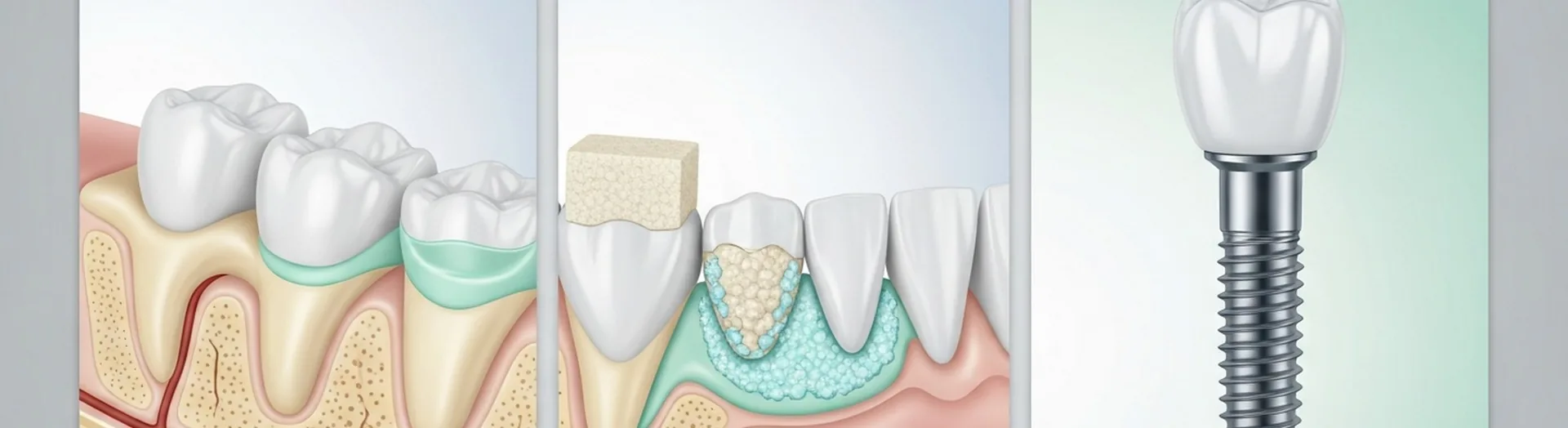
Bone replacement materials
Human bone has the ability to rebuild itself in part. Biomaterials, or bone replacement materials, support the body in regenerating bone that has been lost.
A smaller bone defect can be compensated for with bone replacement materials. The bone replacement material is applied in the area of the defect. We often mix in bone chips in order to promote the regeneration process.

Autologous bone
Minimally invasive transplantation of the patient's own bone
In the case of larger defects in width, of jaw ridges that are too narrow or too flat, of a loss of bone height or of atrophied areas of the jaw, we recommend compensating for the bone deficit by means of a transplantation of the patient's own bone that is as gentle and minimally invasive as possible.
We carry out this bone augmentation using microsurgical techniques in order to keep the strain on our patients as low as possible.
The most important points at a glance
- If bone is missing, the implant site can be built up again in most cases.
- The patient's own bone, bone replacement material or a combination of the two is used.
- Smaller augmentations are often carried out during the same procedure as the implantation.
- Larger augmentations require their own healing period before the implant.